Ceramic Weld Backing and Its Impact on Welding Efficiency and Quality
Understanding Ceramic Weld Backing
What is Ceramic Weld Backing?
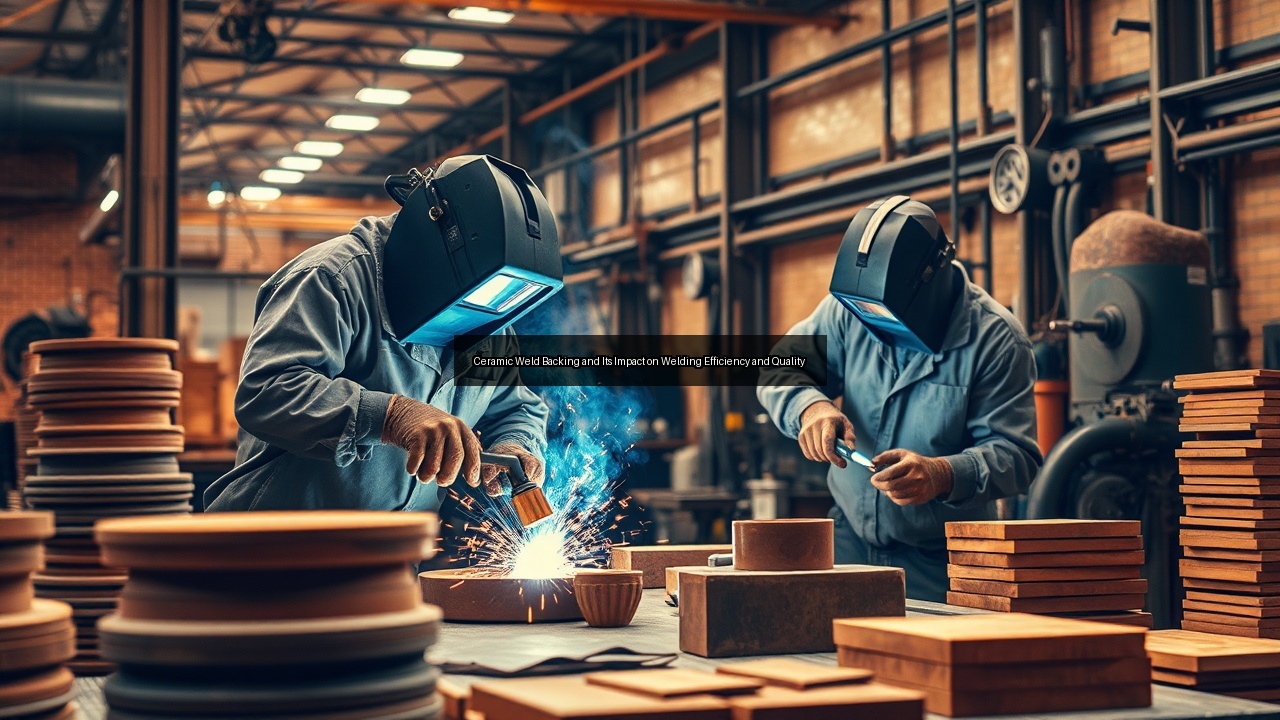
Ceramic weld backing supports the root pass during welding by providing a stable surface that contains the molten pool. Welders place these rigid strips behind the joint to control penetration and eliminate the need for back gouging. The ceramic weld backing maintains consistent weld geometry even on uneven fit-ups. It works effectively with various processes including stick and MIG, allowing the welder to focus on torch angle and travel speed. This approach reduces defects such as lack of fusion or excessive concavity. Many fabricators now rely on ceramic weld backing to achieve full penetration welds in a single pass on structural components. In practice, the backing is positioned with a small gap or directly against the joint root, creating a dam that shapes the weld bead while the arc melts through from the opposite side. This technique proves especially useful on thick plate where complete joint penetration must be verified by radiography or ultrasonic testing without access to the reverse face.
Materials Used in Ceramic Weld Backing
High-purity ceramics form the core of most weld backing products because they withstand intense heat without melting or contaminating the weld. Manufacturers often incorporate refined clay into the mix to improve thermal shock resistance and dimensional stability. Some formulations add fiber reinforcement for added toughness during handling and positioning. These materials resist reactions with oxygen or shielding gases like argon, preserving weld chemistry. The resulting product stays inert even under prolonged arc exposure. Fabricators value this stability when working with stainless or high-alloy steels where inclusions cannot be tolerated. Typical compositions include alumina, zirconia, or mullite bases sintered at high temperatures to achieve densities above 2.5 g/cm³. The low thermal conductivity of these ceramics (often 1–3 W/m·K) ensures that heat remains concentrated in the weld zone rather than dissipating into the backing itself, which helps maintain consistent puddle fluidity across varying amperage settings.
Types of Ceramic Weld Backing Solutions
Common formats include flat strips for plate joints and contoured shapes for pipe and structural sections. Ceramic backing tape offers flexibility for curved surfaces where rigid pieces cannot conform. Pre-glued versions speed setup on vertical or overhead welds. Some solutions combine a ceramic tile core with a foil backing that reflects heat and protects the work surface. Welders select the appropriate type based on joint geometry and required deposition rates. Each variant delivers the same root support while adapting to different welding rod diameters and amperage ranges. Flat strips typically measure 25–50 mm wide and come in lengths up to 1 meter, while contoured versions match common pipe diameters from 4 to 36 inches. Pre-glued tape products incorporate pressure-sensitive adhesives that remain stable up to 300 °C, allowing quick attachment before tack welding begins. Hybrid foil-backed tiles add an aluminum or stainless layer that dissipates radiant heat and prevents discoloration on coated surfaces.
Benefits of Using Ceramic Weld Backing
Improved Welding Efficiency
Ceramic weld backing lets welders complete joints without flipping heavy assemblies or performing back-side grinding. This single-sided access shortens cycle times on large fabrications such as pressure vessels and ship hulls. The backing maintains uniform root reinforcement, so operators spend less time adjusting parameters mid-weld. Reduced interpass cleaning and fewer rejected welds translate directly into higher arc-on time. Shops report measurable gains in daily output when switching from traditional backing methods to ceramic solutions. On a typical 20-meter longitudinal seam in a pressure vessel, elimination of repositioning and grinding can save four to six labor hours per joint while increasing arc-on time from 45 % to over 70 % of the shift.
Enhanced Weld Quality
The non-metallic nature of ceramic weld backing prevents dilution and slag entrapment that often occur with metal backing. Welds show consistent throat dimensions and smooth root profiles without undercut. Shielding gas coverage remains effective because the backing does not create turbulence around the pool. This stability proves especially valuable in TIG applications where argon flow must remain laminar. Fewer repairs mean the final weld meets code requirements on the first attempt. Because the ceramic surface is non-reactive, the root bead exhibits a bright, oxide-free appearance that passes visual and dye-penetrant inspection without additional cleaning. Root reinforcement typically measures between 1 mm and 3 mm, meeting ASME and AWS criteria for full-penetration groove welds.
Cost-Effectiveness in Welding Applications
Eliminating back gouging removes the need for carbon arc equipment and associated consumables. Labor hours drop because one welder completes a joint instead of two operators working opposite sides. Scrap rates decline when root defects disappear. Although ceramic weld backing carries a modest material cost, the overall reduction in rework and consumable use delivers clear savings. Companies track these gains through improved throughput and lower consumable orders for grinding wheels and filler metal. A mid-sized fabrication shop welding 500 linear meters of 25 mm plate per month can reduce annual grinding wheel expenditures by 35 % and filler metal consumption by 12 % after converting to ceramic backing, while simultaneously lowering total man-hours by 18 %.
Applications of Ceramic Weld Backing in the Industry
Industries Utilizing Ceramic Weld Backing
Shipyards, pipeline contractors, and pressure vessel fabricators routinely specify ceramic weld backing on critical joints. The product supports code-compliant welds on thick sections where access is limited. Automotive and heavy equipment manufacturers apply it to frame rails and boom sections to maintain production pace. Power generation facilities use ceramic backing during boiler tube replacement because it tolerates the high preheat temperatures common in those environments. Each sector benefits from faster fit-up and reliable root quality. In offshore wind tower fabrication, ceramic backing enables single-sided welding of 40 mm thick S355 steel cans, reducing tower section assembly time by nearly two days per unit while satisfying stringent DNV fatigue requirements.
Ceramic Weld Backing in TIG Welding
TIG welders pair ceramic weld backing with argon shielding to produce high-purity root passes on stainless and nickel alloys. The backing allows precise control of puddle size without the risk of burn-through on thin walls. Because the ceramic does not react with the gas envelope, welders maintain clean tungsten tips and consistent bead appearance. Many operators prefer this method over open-root techniques when welding schedule 10 pipe or thin plate. The result is smoother internals that require minimal post-weld finishing. On 3 mm wall 316L tubing, ceramic backing permits travel speeds up to 250 mm/min at 90 A while producing a concave root profile free of oxidation, eliminating the need for internal purge dams in many cases.
Case Studies: Success Stories from ESAB and Gullco International
ESAB integrated ceramic weld backing into automated seam welding systems for offshore platform modules, cutting joint completion time by nearly thirty percent. Gullco International developed portable carriages that position ceramic strips accurately along long seams, enabling consistent results across multiple shifts. Fabricators using Gullco equipment reported fewer arc strikes and improved operator ergonomics. Both companies documented reduced consumable spend after adopting ceramic solutions on production lines previously reliant on metal backing or tape. In one documented project, ESAB’s system completed 180 linear meters of 30 mm plate seams in 11 hours instead of the previous 16-hour baseline, while Gullco’s carriage-mounted setups reduced operator fatigue complaints by 60 % on 12-hour shifts.
Comparison with Other Weld Backing Solutions
Ceramic vs. Metal Weld Backing
Metal backing conducts heat away rapidly and can fuse to the weld, creating dilution zones. Ceramic weld backing stays thermally stable and releases cleanly after cooling. Welders avoid the extra grinding required to remove metal backing remnants. Ceramic products also weigh less, simplifying handling on elevated work platforms. These differences become pronounced when welding reactive metals where contamination control is paramount. Copper or steel backing bars can introduce 0.5–2 % dilution of base metal into the root, whereas ceramic maintains dilution below 0.1 %, preserving corrosion resistance in duplex stainless welds.
Ceramic Backing Strip vs. Backing Tape
Ceramic backing strips provide rigid support for flat or gently curved joints and maintain exact root spacing. Backing tape offers conformability on irregular surfaces but can shift under high amperage. Many welders combine both: tape for initial tacks and strips for the main pass. The strip format generally delivers more repeatable root reinforcement when joint gaps vary slightly along the length. When gaps exceed 2 mm, strips maintain consistent 1.5 mm root opening, while tape may compress and alter bead geometry under the weight of molten metal.
Advantages of Ceramic Over Traditional Materials
Ceramic withstands repeated thermal cycles without deformation, unlike fiberglass or flux-coated tapes that degrade quickly. It introduces no metallic inclusions and requires no special surface preparation beyond basic cleaning. The material resists moisture absorption, eliminating hydrogen concerns common with some organic backing products. These properties allow welders to standardize procedures across diverse base metals and thicknesses with minimal adjustment. Unlike flux-coated tapes that release gases at temperatures above 400 °C, ceramic remains dimensionally stable up to 1600 °C, supporting preheat levels of 300 °C common in Cr-Mo steel welding without risk of hydrogen cracking.
Future Trends in Ceramic Weld Backing Technology
Innovations in Ceramic Materials
Researchers continue to refine ceramic compositions for higher thermal conductivity and improved fracture toughness. New binder systems allow thinner profiles that still support heavy deposition rates. Some manufacturers now embed sensors within the backing to monitor temperature during welding, giving real-time feedback to automated systems. These advances expand the range of applications into higher-strength alloys and thicker sections previously considered unsuitable for single-sided welding. Nano-structured zirconia additions have raised fracture toughness from 3 MPa·m½ to over 5 MPa·m½, allowing thinner 8 mm profiles to support 350 A submerged-arc welds without cracking.
Impact of Fiber and Foil Technologies
Hybrid designs combine ceramic tiles with flexible fiber mats and reflective foil layers. The fiber adds tensile strength for handling long strips without breakage. Foil reflects radiant heat away from adjacent components, protecting coatings and reducing distortion. Welders report easier positioning and cleaner removal after the weld cools. These layered solutions appear increasingly in field repair kits where weight and versatility matter. Recent foil-fiber-ceramic composites weigh 30 % less than solid strips while providing equivalent root support on 50 mm thick plate.
Sustainability in Welding: The Role of Ceramics
Ceramic weld backing reduces overall energy consumption by shortening weld cycles and eliminating secondary grinding operations. The inert material can often be recycled into refractory products after use, lowering landfill contributions. Fabricators seeking lower carbon footprints appreciate that ceramic solutions require fewer consumables than multi-pass techniques with metal backing. Continued adoption supports broader industry goals around resource efficiency and waste reduction in welding operations. Life-cycle assessments indicate that ceramic backing can lower the carbon footprint of a typical pressure-vessel weld by 22 % compared with traditional back-gouging and multi-pass methods, primarily through reduced electricity use and grinding dust generation.
See Also
- Ceramic Weld Backing vs Traditional Methods What You Need to Know
- The Future of Welding Technology Ceramic Backing Innovations
- Mastering the Art of Welding with Ceramic Backing Techniques and Tips
- Enhancing TIG Welding Performance with Ceramic Backing Solutions
- Choosing the Right Ceramic Weld Backing for Your Specific Welding Needs